
"Only in Minnesota"
Only in Minnesota can we expect dramatic swings in our weather from depressingly meager snow levels all winter to 13 inches of snow overnight. After all, historically our biggest snow events usually coincide with the Minnesota State High School Basketball Tournaments.
Near record warm temperatures the past few weeks have melted what snow we did receive and pulled most if not all the frost out of the ground. These extremes confuse plant life and create new challenges for wildlife.

In the morning of March 2nd, I noticed the sapcicle hanging from a sugar maple tree along the trail.This was proof positive the maple syrup season had arrived.
These ice formations are usually a result of an injury to the tree. Back in my ELC days, participants hiking through the woods this time of year would be excited to find these refreshing treats.

Two days later while walking in our backyard, I discovered numerous freshly snipped pine boughs underneath two Norway Pine trees. Evidently our neighborhood gray squirrels became aware of the flowing sap in these trees as well. As the food supply diminishes for squirrels by the end of the winter, they chew off the boughs and drink the flowing sap.
In a recent visit with Barry Stockwell of the S and S Sugarbush, he informed me of his transition of collecting sap in plastic bags to hard plastic pails. His resident squirrels found it too easy to chew a hole in the bag and drink the sap.

You may or may not remember there were several major snow events in our area during the winter of 2018/2019. Then on March 13 and 14 of 2019, we experienced a most unusual rain event melting a significant amount of the snow cover.
The result was a dramatic rise in the water level of Wacouta Pond. Land remaining out of the high water and adjacent to Wacouta Road proved to be an ideal habitat for two pairs of Canada geese to establish their nests.

If you were fortunate to be driving by at the right time on lower Wacouta Road after the goslings hatched, it was likely you witnessed their activity. These opportunities existed for the next couple weeks.
You might also remember the high water in the pond lasted all summer. That high water level was the result of the river staying high at the same time. At normal water levels the difference in elevation between the pond and the river is less than 10 feet!

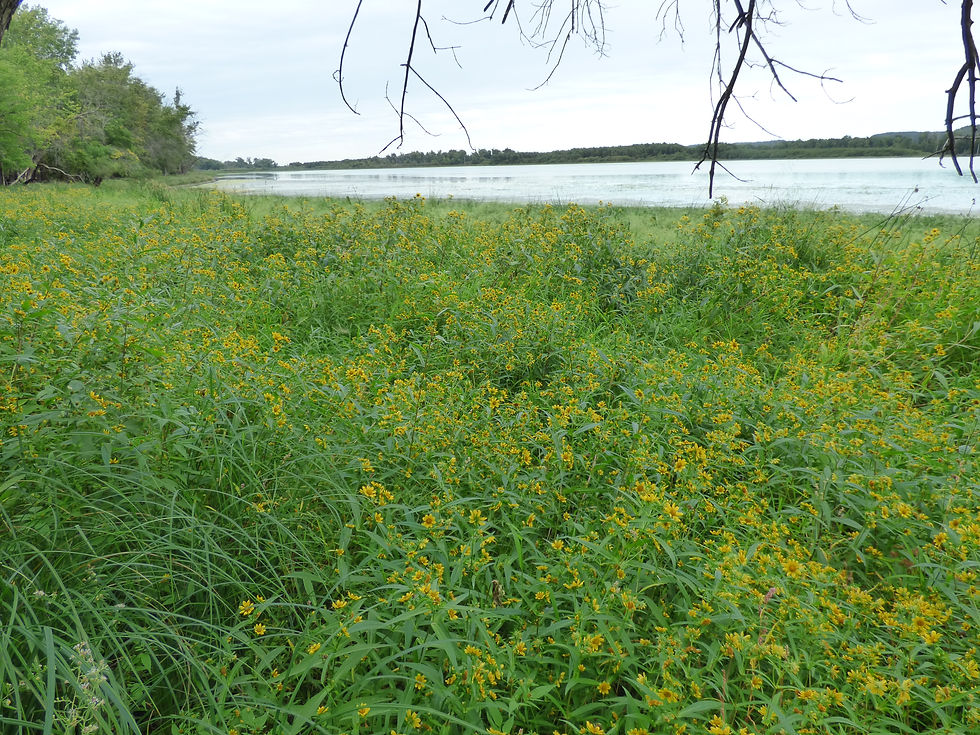
I took this photo on March 12, 2026 at the west end of the pond. This unusually low water is the result of low water levels on the river last summer and fall along with little precipitation since.

On March 2nd, I heard my first significant call of spring as six different flocks of migrating sandhill cranes flew overhead. They were flying fast and high, but their distinct trumpeting calls were still very audible.

As I stepped out the front door in the early morning of March 8th, I was greeted by bright sunshine, clear blue skies, a light southeast breeze and bird calls everywhere. It was as if someone had turned a switch and brought everything to life.
Robins in the yard singing "cheerily cheer-up cheerio"
Cardinals in some brush near our house singing "cheer cheer, cheer"
Bluebirds high up near the top of a maple tree singing "chur chur lee chur lee"
Red-Winged Blackbirds singing "konk la reee"
To top the morning off, hearing and observing large flocks of Canada Geese, Cormorants, Trumpeter and Tundra Swans all heading northwest with no intention of stopping anytime soon.

We woke up Sunday morning March 15 to 13 inches of wet heavy snow.
Snow I had been waiting for all winter.

As daylight was breaking, the first sign of life I observed were two deer slowly browsing on brush in our backyard. I am sure they thought with the warm weather we have been experiencing early in the month, they had dodged another winter season. What a surprise.

The first hungry bird to show up at our feeders was this colorful cardinal.
Needless to say, our feeders were completely covered in snow. Once they were cleared out and food replaced, plenty of activity took place the rest of the day.

Last June with the help of Wacouta resident Dave Mcdougall, a kestrel nesting box was set up in the prairie just east of Wacouta Road. It is clearly visible from the road.
Most kestrels migrate south for the winter and return around the end of March.
Please keep an eye out for them around the nesting box or perched on the wires across the road. Let me know if you see any sign of them. Thanks.


I'll bet Wacouta is the only township in the state -- possibly the nation -- where we have a blow-by-blow description of the seasons and wildlife -- local and passing -- in such colorful and informative detail. The township ought to designate Bruce as official natural observer. Thanks much. Marilyn and Arlin Albrecht
Another wonderful post. And that snowstorm was really something! Wish we got more like that.