
"Climate Change Brings Wild Swings Of Fickle Spring Weather"
Late winter wet heavy snows, rain, strong winds, freeze warnings and extreme fire warnings all add up to major challenges for migrating birds, trees and local flora.
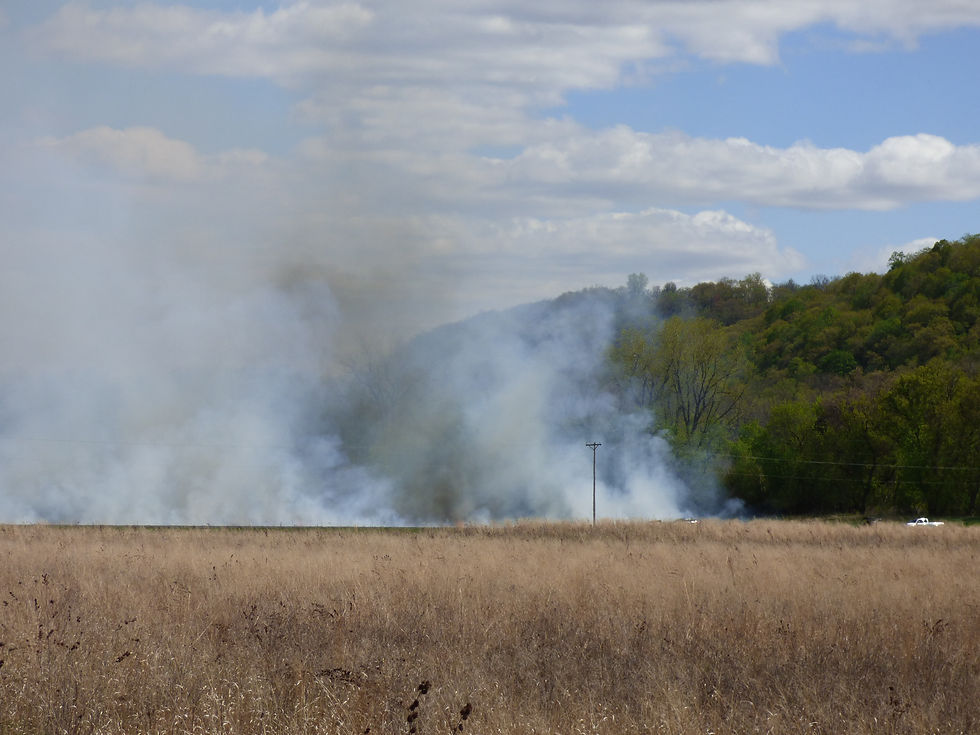
On Thursday afternoon of April 30th, the Prairie Restoration Company conducted a prescribed burn on the third and final section of the Wacouta prairie. Fortunately the northwest breeze kept the heavy smoke away from folks living along Lakeview Ave.
Prairie Restorations has helped private individuals and non-profit organizations across Minnesota develop healthy prairies and landscapes for 40 years.


On May 9th, I started to observe the first blooming prairie plants in the section of prairie burned in the spring of 2025. Lupines were once thought to deplete or "wolf" the mineral content of the soil, hence the genus name lupus.
Actually these plants are members of the pea family and enhance the soil fertility by fixing nitrogen into a usable form.

For the past two weeks as I walked the trail in the woods on the western section of prairie, I have been observing Virginia Bluebells in full bloom.
If I remember correctly, Friends of Wacouta volunteers successfully transplanted those colorful woodland plants several years ago.

I learned from Pam Miller's Frontenac State Park Association monthlynewsletter that a pair of resident sandhill cranes were nesting on the eastern end of Frontenac Pond. Given the fact they usually nest in very secretive areas of vegetated wetlands, I made the effort to hike in and see if I could capture a photo for this blog post.

As I was watching the nesting crane, an adult bald eagle flew low and directly over the crane. It immediately attempted to move into a defensive position. Female cranes typically lay two eggs. Unfortunately in most cases, only one survives to fledge.

As I have mentioned in earlier posts, a pair of trumpeter swans were frequently observed on Wacouta and Frontenac Ponds last summer and fall. This spring a pair of swans has established a nest on the pond in the DNR Perched Valley Wildlife Area to the east of Wacouta Pond.
If you look closely, you will see the nesting swan has a red head. This is a result of environmental staining from iron-rich wetlands. The swans absorb these minerals naturally when they submerge their heads to feed.

The past couple weeks we have had a remarkable variety of spring migrating bird species visiting our feeders. Here is a list of those species.
Gray Catbird
Yellow-rumped Warbler
Song Sparrow
White-throated Sparrow
Rose-breasted Grosbeak
Orchard Oriole
Baltimore Oriole
Ruby-throated Hummingbird

With the impressive list of species, the same can't be said about their numbers
at this time of the spring.
In previous years, it was not uncommon to count up to 20 orioles at a time visiting our jelly and nectar feeders. This year our highest count has been 6. We have only observed 1 hummingbird as of today!

Without a doubt the most exciting bird observation at our feeders has been a Red-headed Woodpecker. It appeared at our peanut feeder very briefly on two successive mornings.
Unfortunately over the past 50 years, there has been a 95% decline in their numbers. This drop in numbers has been attributed to habitat destruction, competition for nesting sites and modern human development.


Sorry to hear about the decline of the red headed woodpecker.
This has been very informative and makes me want to explore the prairie more often, thanks.