
"Late Summer Prairie Flora, Monarchs, Killer Wasps AndSplooting Squirrels"
The last couple weeks have featured new floral arrivals, unlikely predators and interesting animal behavior.

Earlier this summer, Black-eyed Susans were easily observed along the trail next to the Wacouta prairie.
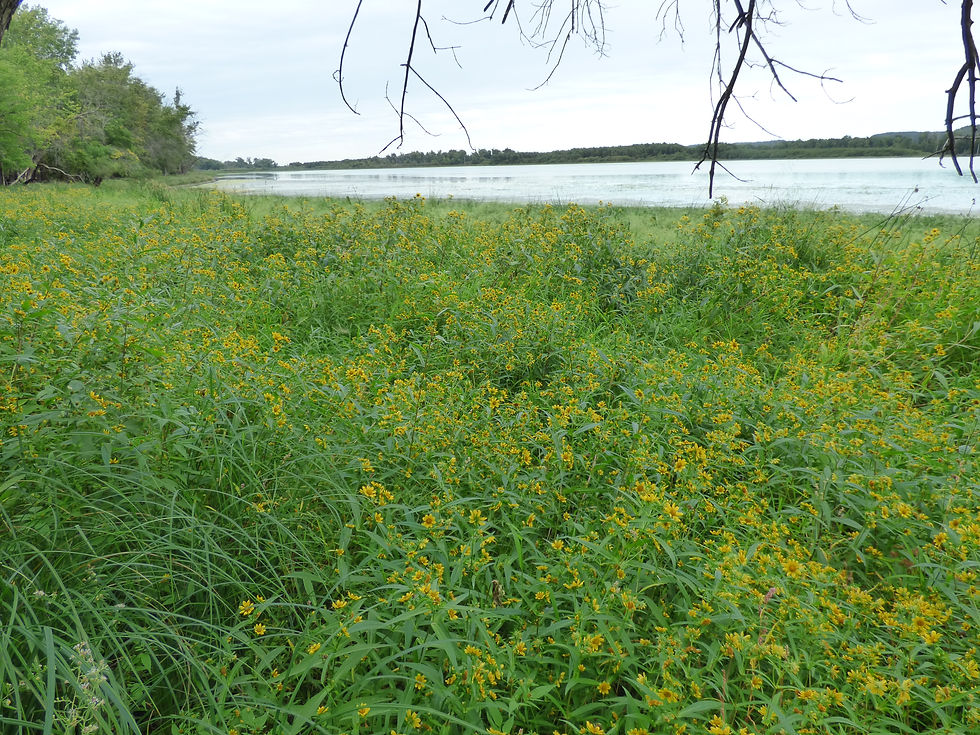
In the past couple weeks, dense patches of Brown-eyed Susans are being observed along Lakeview Ave. These wildflowers are easy to identify by the bristly,hairy and reddish green stems.

Another recent blooming prairie plant along the trail is the bright yellow Partridge Pea. If you look closely, numerous small bees are attracted to these flowers.
Touching the leaves of this plant will cause them to collapse earning them the name of sensitive plant.

Another late arrival on the scene is Horsemint. The crushed leaves and seedheads of this plant give off a wonderful pungent odor useful in preparing a refreshing cup of tea.

You may have noticed the past couple weeks the appearance of clumps of purple flowers in the wetlands along Highway 61 between Wacouta and Red Wing.
Purple Loosestrife is a tall invasive wetland plant imported from Europe to serve as a decorative garden plant and as an abundant source of nectar for honeybees. It damages wetland areas by crowding out native plants and blocking the flow of water.

In the past couple weeks, I have noticed an increase of monarch butterflies feeding on the flowers of the Canada Goldenrod. In the evenings, more and more monarchs are coming in to roost in the trees of our backyard adjacent to the prairie.
According to Wacouta resident monarch expert Diane Mueller, this is the leading edge of the fall monarch migration. For those of you who follow this migration, Diane feels the peak of that migration at this latitude will be around the 8th of September.

With the number of monarchs in our area this summer, Kathy and I have been surprised to see virtually no feeding of monarch larva on common milkweed in our yard or on the trail.
We reported this observation to Diane and she confirmed the same observation. However, she passed along a photo of monarch larva feeding on Swamp Milkweed in her garden.

This photo comes from our neighbors Steve and Sue Betcher following a recent observation by their grandsons. They had noticed a large wasp had captured a cicada and was trying to bring it into a hole in their yard near the house.
Killer wasps will actively hunt, sting and paralyze cicadas to feed their young in underground brood chambers. The female wasp places their prey in the chamber, lays an egg on it and seals the entrance so the hatched larva has a source of food.

During our really hot weather in August, it was not at all uncommon to observe our resident gray squirrels seeking shelter from the heat by taking advantage of the shade on our patio by laying under Kathy's flower baskets. Because squirrels can't sweat, they will cool off by splooting.

By pressing their thinly furred bellies against a cool shaded surface to transfer excess body heat away from their body.

Kathy and I were fortunate to have our daughter Ena and grandson Trygve visit us from Norway for a couple weeks in August. One evening, we paddled up into Wacouta Bay as a colorful red sunset was taking place. The colors of the sunset were enhanced by the smoke from wildfires in northeast Minnesota and Ontario.
As a matter of record, the river level this summer has been at record low levels most of the time. On August 21 the river level in Red Wing was 2.1 feet. The all time record low level since the lock and dams were constructed in the 1930's was 1.8 feet. That occurred in the summer of 2003.


I have wondered what the unique horsemint was named. Thanks! We rode to the head of the lakes with John Plehal last week and saw the egrets. Have also seen circling gulls several times-once close over us as we canoed down No Pt. and several years over the prairie.
Always enjoy your blog. I especially liked the splotted squirrel. It is always interesting to see how animals adapt.
Very interesting! Thanx Bruce
Another informative post and the pictures that complement the stories are great,
and Like the abiltity to enlarge the photo as well. Thanks